
Following what has been the hottest July on record in Somerset, and I imagine the driest too, we are hoping for some rain in August. Because June was so wet here in Wells, the gardens have developed well. It was initially the extremely strong and hot sunshine that affected some plants, rather than the dry ground.
During these periods, it is good to make time to walk around the gardens and look at what has thrived in the sun without requiring any watering. In some areas, we do use sprinklers to keep planting fresh and encourage flowering. We started watering some of the borders in the fourth week of July, but tend to only do so during the most extreme weather conditions.
We used lots of mulch throughout the gardens this spring, which has made a big difference by helping to retain moisture in the ground. We constantly assess plants that struggle in dry conditions and tend to replace them with more reliable species, unless they provide exceptional displays earlier in the season.
To find inspiration for plants that will survive hotter, drier summers, we have some excellent examples at the Bishop’s Palace. The border facing the south lawn, which is a real suntrap, does not receive irrigation and all the plants are thriving. Plants such as Euphorbias, Rosemary, Phormium, Arbutus (strawberry tree) and the large herbaceous plant Persicaria polymorpha, with its sprays of creamy white flowers that last for weeks, are all performing well.
The medium-sized shrub Hibiscus syriacus has beautiful and distinctive exotic blooms in a range of colours and is ideal for a south or west-facing wall or location. Alternatively, climbers such as yellow, orange or red trumpet vines also thrive in heatwaves and produce lots of trumpet-shaped flowers.
Herbaceous plants such as the striking violet-blue flowers of Agapanthus ‘Northern Star’, feather grass Stipa tenuissima, Hylotelephium (Sedums), Artemisia species, and many roses, including ‘Young Lycidas’, ‘Just Joey’, ‘Sally Holmes’ and ‘Darcey Bussell’, are all thriving.
With a little more space, you could try the hardy but exotic-looking Japanese banana Musa basjoo. Alternatively, if you provide some winter protection, the brilliant orange Canna ‘Durban’ is also a very flamboyant choice.
I think the standout plant that requires no additional watering and thrives in hot, dry summers is Eriolarynx australe (mini angel’s trumpet). With its pendant lavender-blue or white flowers and glossy green foliage, it can become a medium-sized shrub, although it may require protection during harsher winters. These plants have been thriving in Milton Lodge Gardens for many years and were originally gifted several years ago.
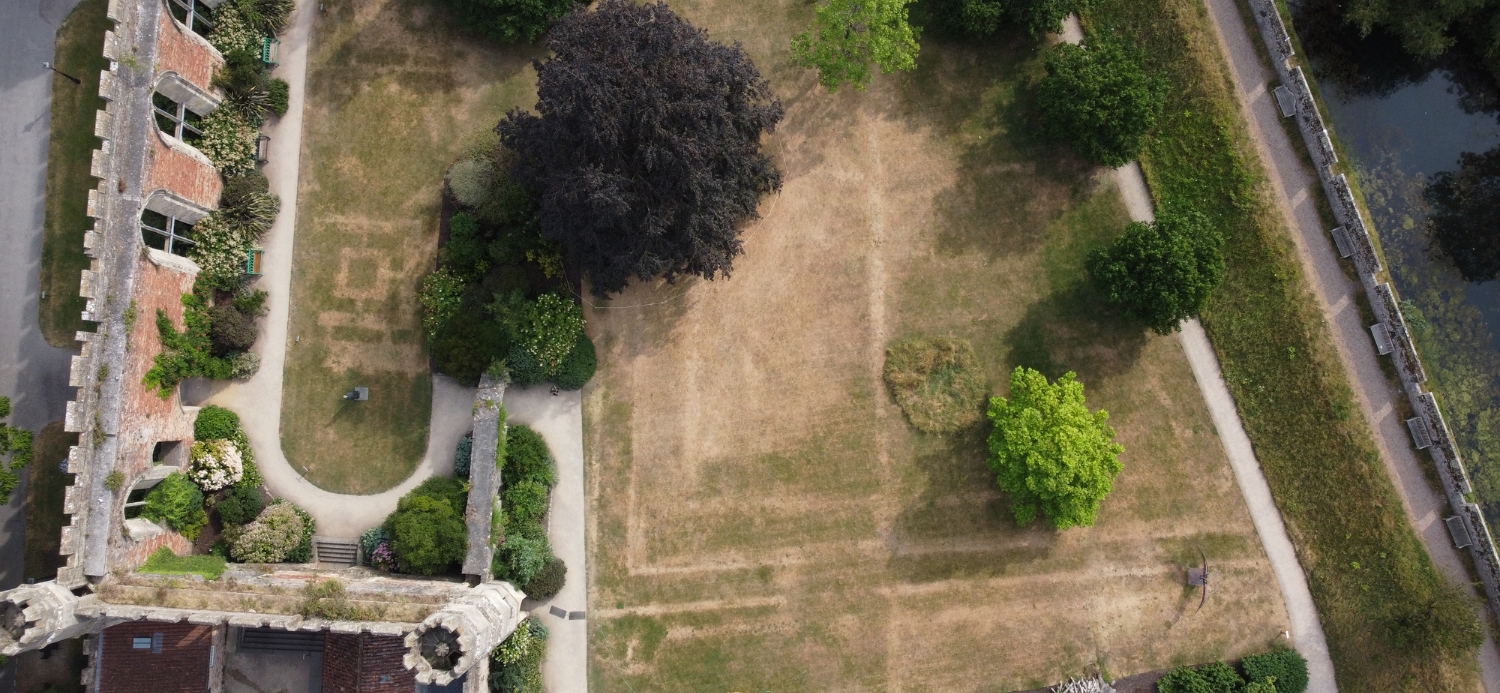
I have also included a picture showing the outlines of some Dutch-style gardens that we were not previously aware of and which probably date from somewhere in the mid to late 1700s. We have not noticed them during previous droughts, although drones have made them far easier to spot. The lines were probably gravel paths, with short-clipped grass or box hedging between them. At this time, the Great Hall walls were still intact, apart from the roof.
James Cross, Head Gardener
For more content about our gardens, as well as behind-the-scenes videos with our gardeners, visit our social media pages via the icons below.